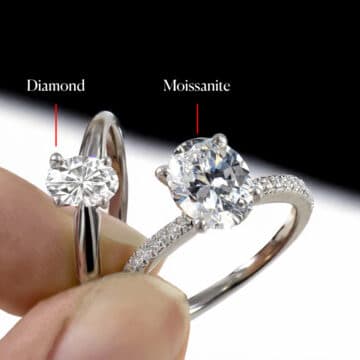

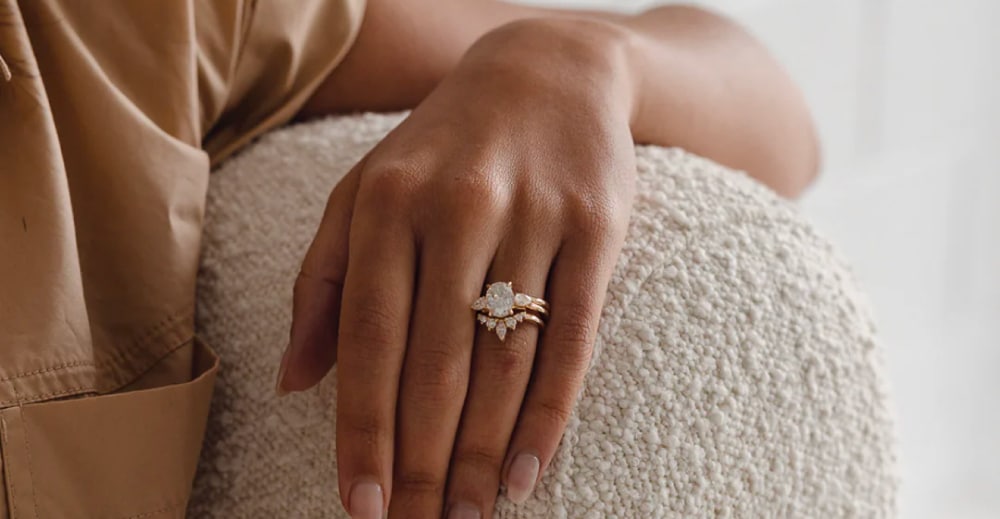

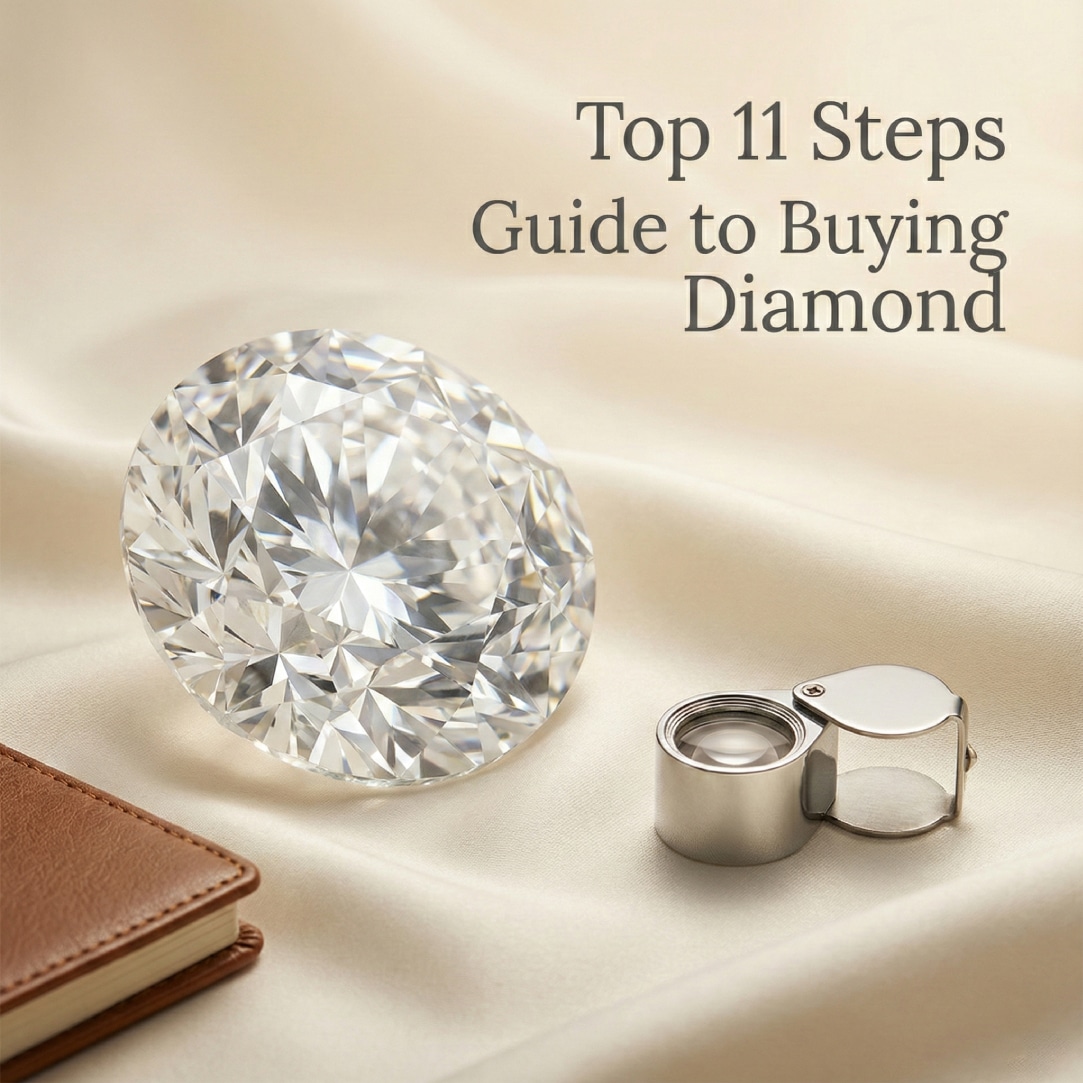
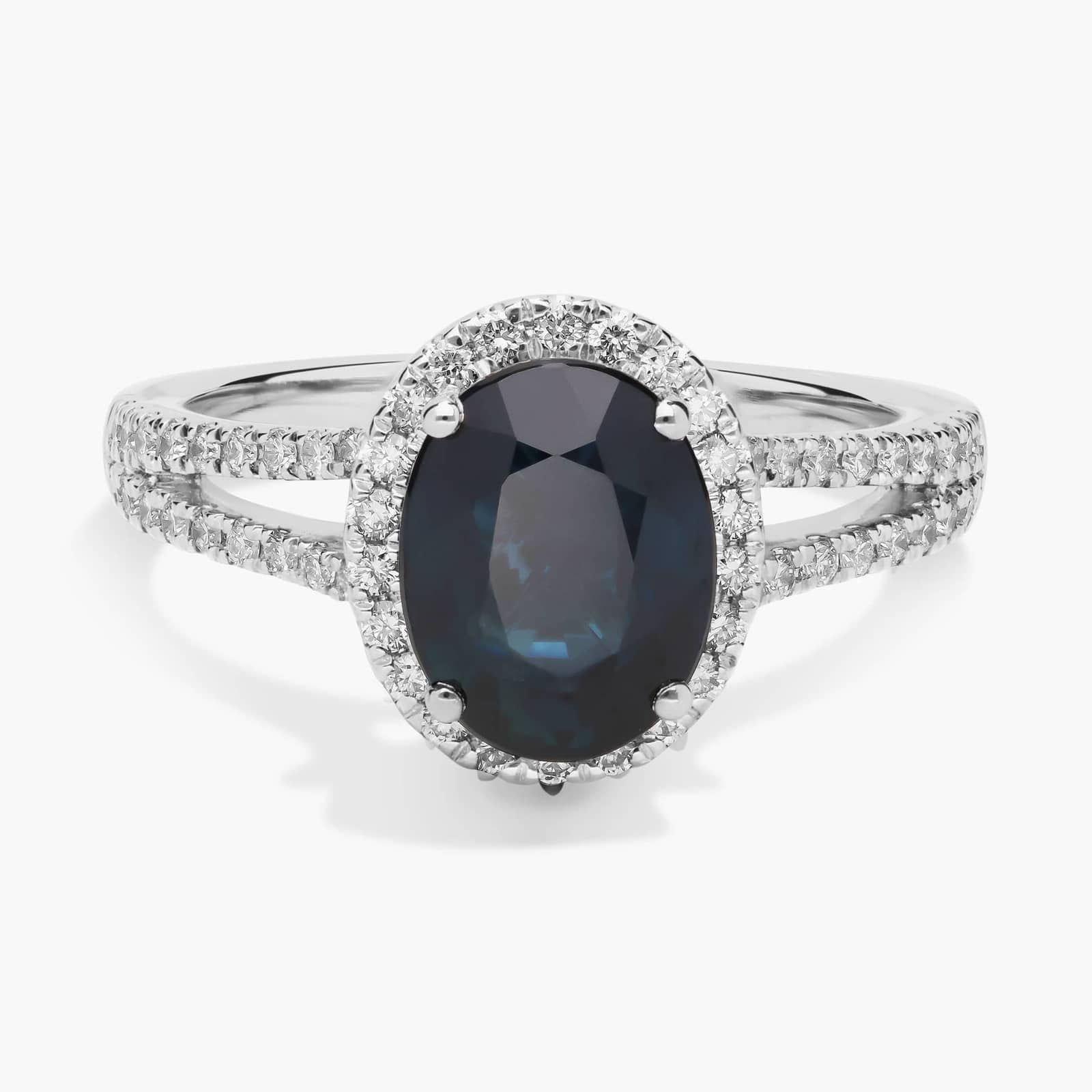

In direct sunlight, the difference between diamond and Moissanite is undeniable. Moissanite exhibits the “Disco Ball Effect,” flashing intense rainbow colors (fire) due to its higher refractive index (2.65). Diamond, by comparison, reflects more white light (brilliance) with subtle, sophisticated flashes of color. If you love maximum color, Moissanite wins. If you want crisp, icy white sparkles, Diamond is the superior choice.
I hear it all the time from my clients: “Mehedi, I don’t want my ring to look like a toy in the sun.”
It is a valid fear. Sunlight is the ultimate lie detector for gemstones. You can hide a stone’s quality under dim jewelry store lights, but the sun reveals the true soul of the stone instantly. It strips away the marketing fluff and shows you exactly how the light behaves.
Deal Alert: Fast-Shipping Gifts — Up to 50% Off* fine jewelry at Blue Nile !
One In A Lifetime Sale: “Clear The Vault” – Get up to 70% OFF on select jewelry at Blue Nile !
Exclusive Offer: Flash Sale on James Allen Up to 40% Off * Sitewide engagement ring settings & Fine Jewelry at James Allen .
I’m not here to sell you one or the other. I’m here to give you the unfiltered truth. In this guide, I’m going to show you exactly why Moissanite explodes with color, why Diamond stays cool and crisp, and help you decide which light performance actually fits your style—and your budget.
Think You’re A Moissanite Pro?
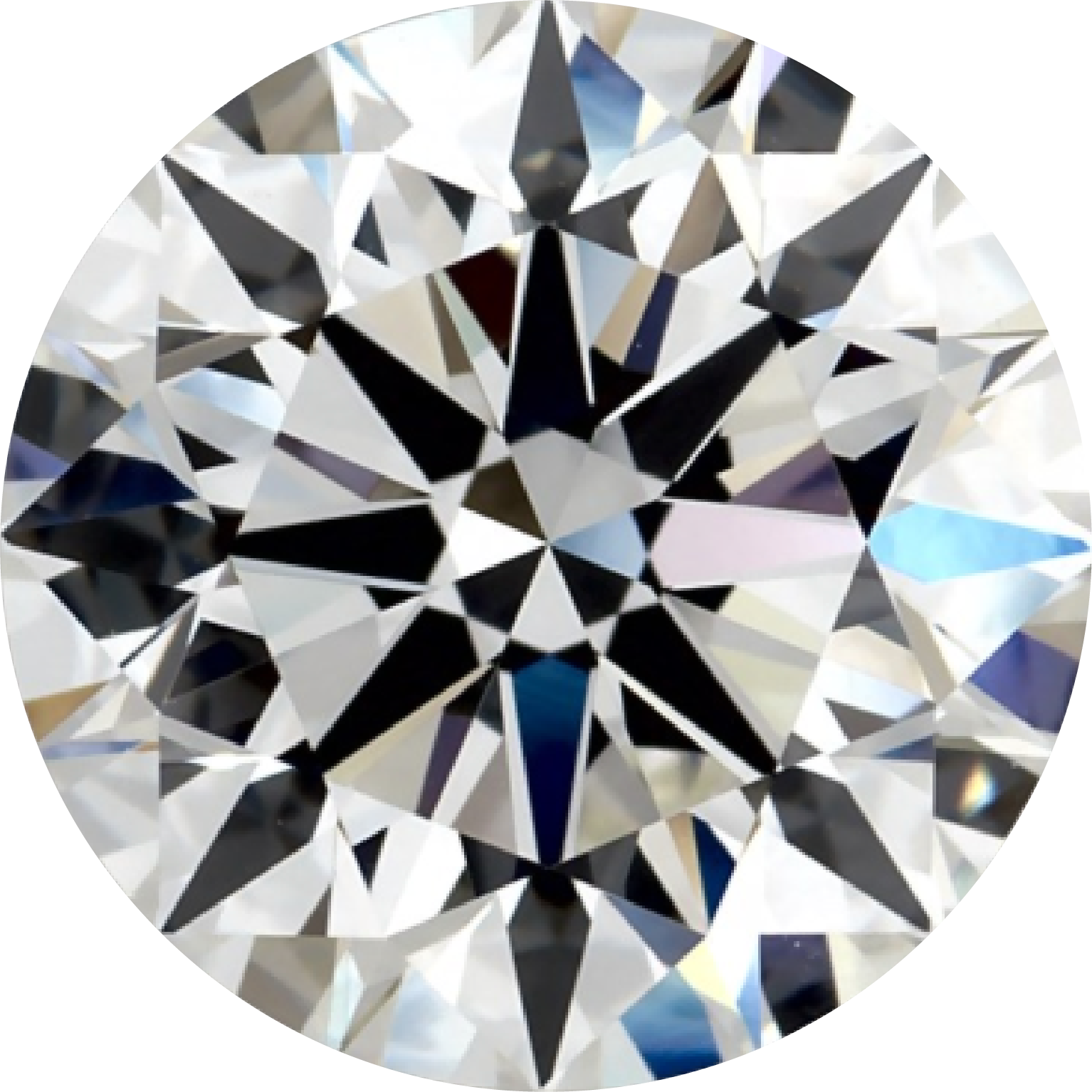
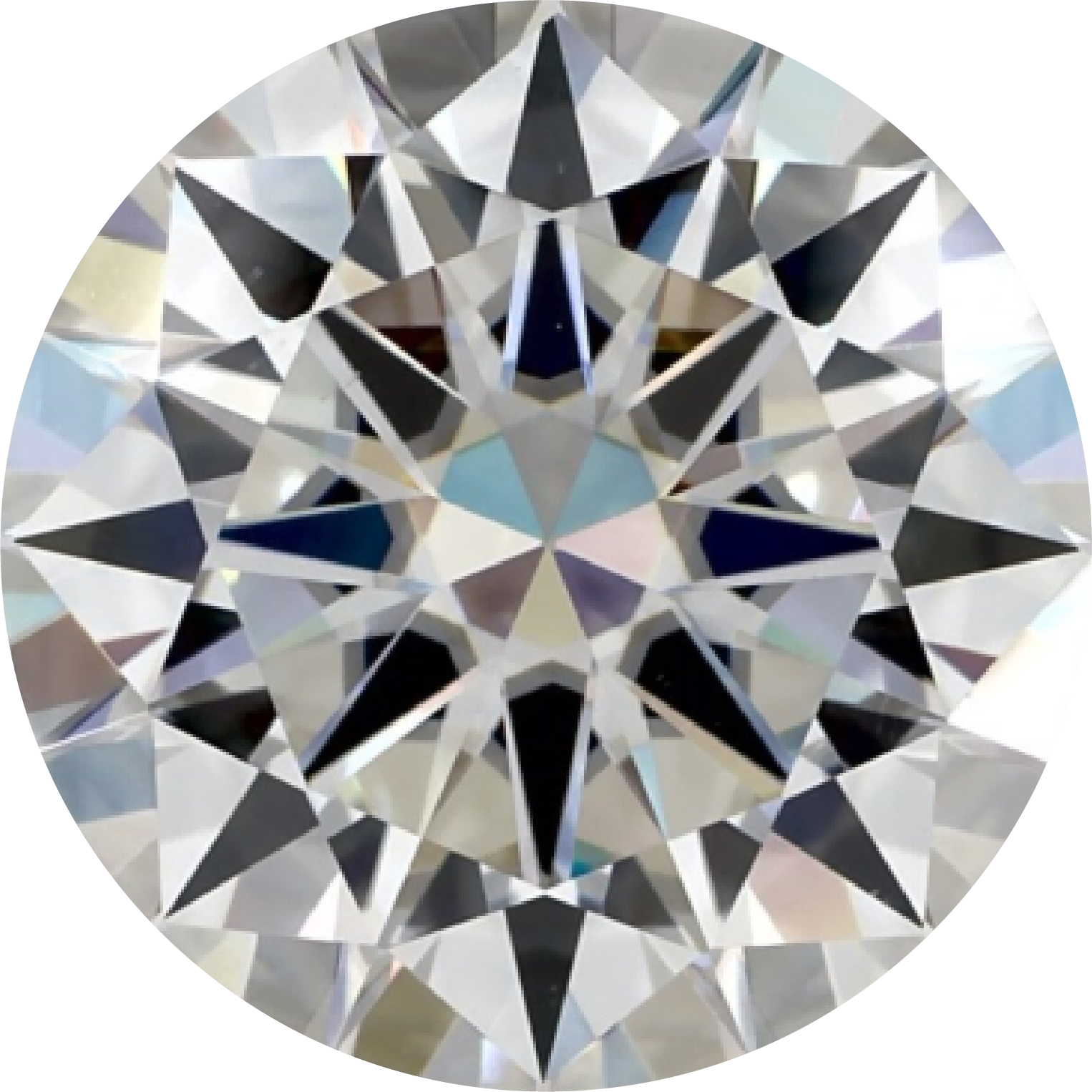
Think you’re a Moissanite Pro and can tell the difference? Choose the gemstone that you like better. Is it the one for $1,180 or the one for $39,000? Both are 2.48 carats.
The Science of Sparkle: Why They Behave Differently
I promised I would show you the “soul” of these stones, and to do that, we have to look at the physics. Don’t worry, I’ll keep it simple. There are two scientific measurements that dictate exactly how a gem handles sunlight:
- Refractive Index (RI): Think of this as the “Brilliance Score.” It measures how much light the stone slows down and bends. A higher number means more light is trapped and bounced back to your eye as white sparkles.
- Dispersion: This is the “Fire Score.” It measures how well the stone acts like a prism, splitting white sunlight into rainbows (reds, blues, yellows).
Here is the undeniable data. This table isn’t an opinion; it’s the law of physics.
The Data Table: The “Fire” Gap
| Gemstone | Refractive Index (Brilliance) | Dispersion (Fire/Rainbow) | Mehedi’s Take |
|---|---|---|---|
| Diamond | 2.42 | 0.044 | Classic, balanced, and sharp white light. |
| Moissanite | 2.65 – 2.69 | 0.104 | 2.4x more fire. Explodes with color and rainbow flashes. |
The Reality Check:
Look at that Dispersion column. Moissanite (0.104) is scientifically more than double the dispersion of Diamond (0.044).
This means that while a diamond does break light into rainbows, it does it subtly. Moissanite, on the other hand, is a powerhouse. It takes a single beam of white sunlight and shreds it into a full-spectrum kaleidoscope.
For a deeper dive into these metrics and what they mean for your wallet, check my full breakdown: Which is More Sparkly: Diamond or Moissanite?.
The “Disco Ball” Effect: Feature or Flaw?
Now that you know the numbers, let’s talk about what this actually looks like when you step outside for lunch on a sunny Tuesday.
This is what we call the “Disco Ball Effect.”
Because Moissanite has that massive 0.104 dispersion rating, direct sunlight triggers an intense display of rainbow flashes—reds, oranges, yellows, greens, and violets shooting out from every facet.
The Controversy
This is where the debate gets heated.
- Team Diamond: Critics say this intense rainbow effect looks “fake” or “too busy.” They argue that diamonds have a crisp, “steely” white return that looks more serious and expensive.
- Team Moissanite: Fans argue that the diamond looks boring in comparison. They see the rainbows as “magical” and “alive.” To them, more sparkle equals more beauty.
My Analogies:
- Diamond is Mozart: Classical, precise, elegant, and timeless. It commands respect with a whisper.
- Moissanite is Rock & Roll: Loud, colorful, energetic, and impossible to ignore. It demands attention with a shout.
Neither is “wrong.” But you need to know which band you want to listen to for the rest of your life.
Don’t just take my word for it—physics is better seen than read. I took a natural Diamond, a Moissanite, and a Lab Diamond out into the midday sun so you can see the “Disco Ball” effect with your own eyes.
Watch closely: notice how the center stone (Moissanite) throws wild rainbows, while the Diamonds keep that crisp, white contrast.
Sunlight vs. Indoor Light: The Chameleon Effect
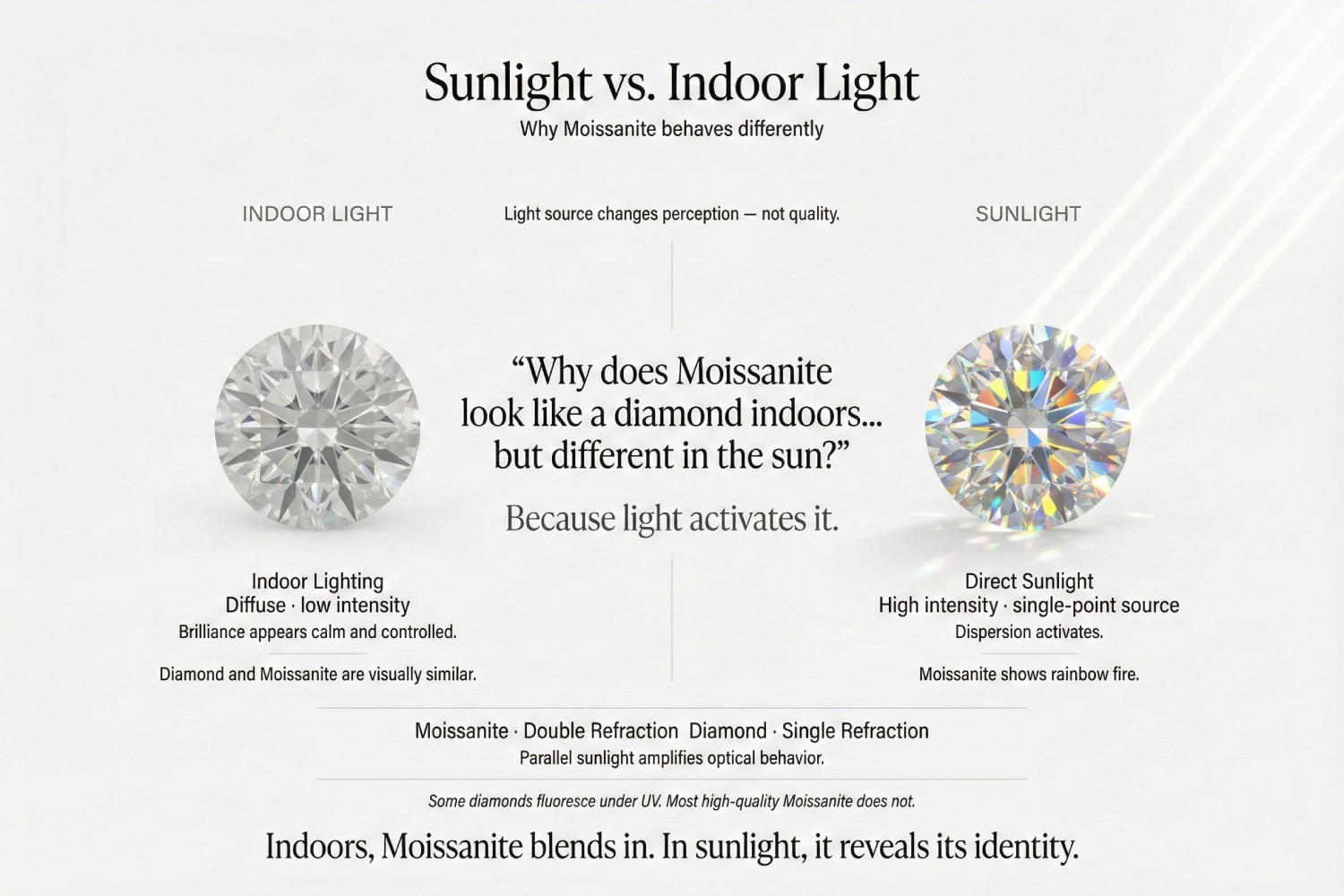
This is the part that catches most first-time buyers off guard. You might unbox your ring in your kitchen, look at it under the soft LED lights, and think, “Wow, this looks exactly like a diamond!”
And you’d be right. But Moissanite is a chameleon. Its personality changes completely depending on the light source.
Indoors: The Great Equalizer
Under standard indoor lighting—like office fluorescents or warm living room bulbs—the playing field is surprisingly level. Diffuse lighting doesn’t provide the intense, direct beams needed to trigger Moissanite’s extreme dispersion.
- The Look: Both Diamond and Moissanite will appear calm, clear, and brilliant.
- The Difference: It is incredibly difficult for the untrained eye to tell them apart in these conditions. If you work in an office, your Moissanite will pass as a diamond 99% of the time.
Outdoors: The Sun is the Activator
The moment you step outside, the game changes. The sun is a massive, single-point light source that hits the stone with high-intensity parallel beams.
- The Reaction: This direct hit activates the “double refraction” property of Moissanite. The stone wakes up.
- The Result: While the diamond remains composed and “steely,” the Moissanite begins to throw those signature rainbow flares. The contrast between the two becomes obvious to anyone paying attention.
A Note on UV Interaction
We can’t talk about sunlight without talking about UV rays. The sun is blasting your ring with ultraviolet light.
- Diamonds: About 30% of diamonds have a trait called “Fluorescence,” where they glow (usually blue) under UV light. In strong sunlight, a diamond with Strong Blue fluorescence might look slightly milky or oily.
- Moissanite: Generally, high-quality Moissanite is inert (doesn’t glow). However, strange lighting conditions can sometimes make stones behave unexpectedly. If you’re curious about these rare scientific quirks, I wrote a deep dive on Moissanite Under UV Light.
The “Icy” vs. “Warm” Factor
There is one more secret the sun reveals: Body Color.
When we talk about sparkle, we usually talk about “White” (Brilliance) vs. “Rainbow” (Fire). But there is a third element: the actual tone of the stone.
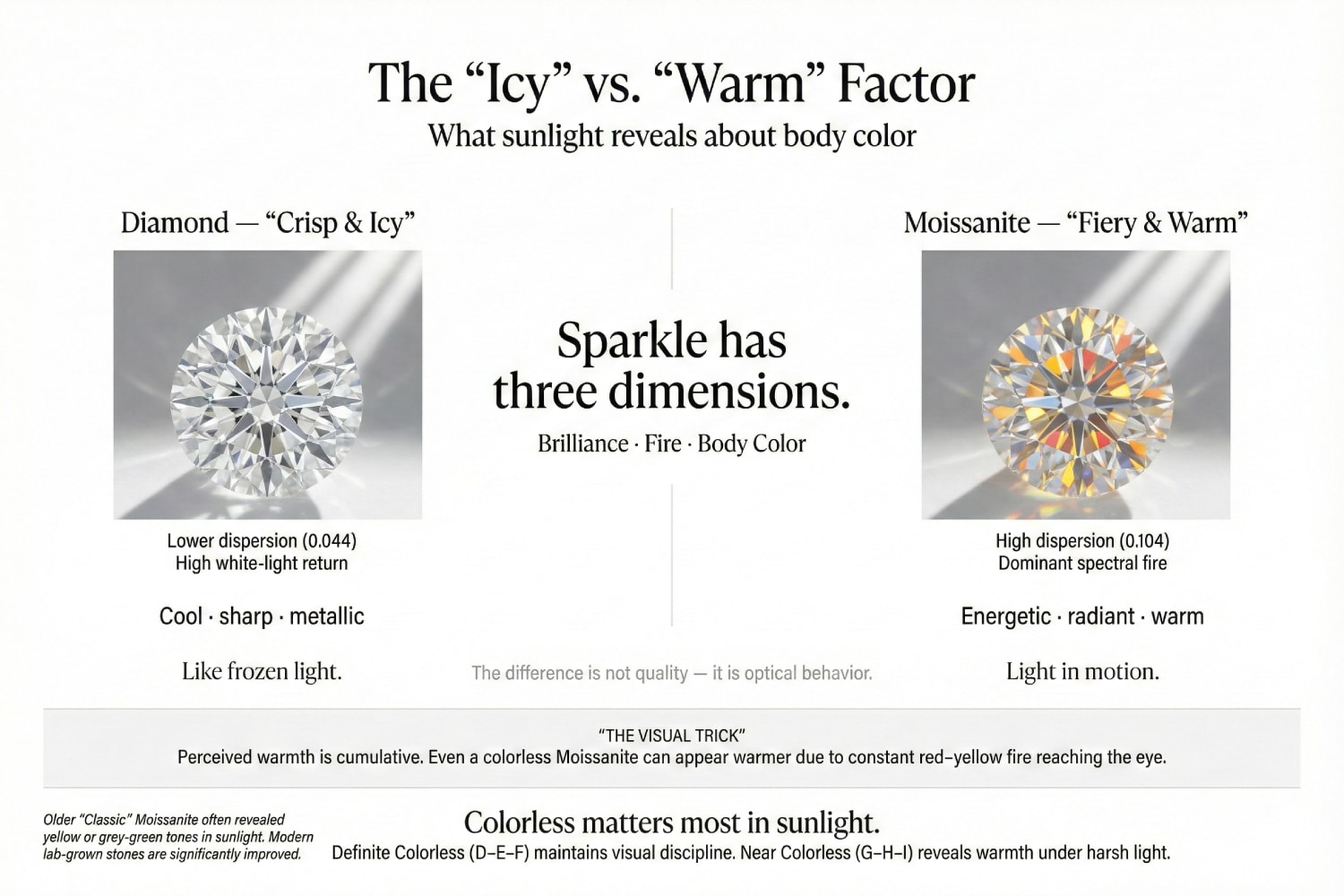
The Diamond Look: “Crisp & Icy”
Because diamonds have lower dispersion (0.044), they return a lot of white light. This creates a “Crisp” or “Icy” appearance. Even in the sun, a high-quality diamond looks like a shard of frozen ice—cool, sharp, and metallic.
The Moissanite Look: “Fiery & Warm”
Because Moissanite is exploding with red, yellow, and orange rainbows, the cumulative effect can look “Warmer.”
- The Visual Trick: Even if your Moissanite is graded “Colorless,” the sheer amount of colorful fire reflecting in your eye can make the stone feel warmer than a diamond.
- The “Yellow” Fear: In the past (with older “Classic” Moissanite), sunlight was brutal. It would reveal a nasty yellow or grey-green tint. Today’s modern lab-grown stones are far superior, but sunlight is still unforgiving if you buy a lower grade.
Mehedi’s Recommendation: Go Colorless or Go Home
If you want your Moissanite to look as close to a diamond as possible in the sun, you have no room for error on color grade.
- The Rule: You must buy Definite Colorless (D-E-F) range Moissanite.
- The Warning: If you buy “Near Colorless” (G-H-I) to save money, the sun will expose that slight warmth. Combined with the rainbow fire, a G-H Moissanite can look distinctly “not diamond” when you are driving in your car with the sun roof open.
Don’t guess on this. I’ve broken down exactly what these grades look like side-by-side in my Moissanite Color Chart.
Here is the final part of your A++++ rewrite, including Mehedi’s Verdict, the 10 AI-Optimized FAQs, and the Conclusion.
I have crafted the FAQs to specifically target the “Voice Search” queries (e.g., “Does it look fake?”) that real users ask their devices.
Mehedi’s Buying Verdict: Which Sparkle Suits You?
We’ve looked at the physics, the “Disco Ball” videos, and the color charts. Now, it’s time to make a decision.
When clients ask me, “Mehedi, which one is better in the sun?”, my answer is always: Better for who?
There is no “better,” there is only “preference.” Here is how I categorize the two distinct looks so you can match them to your personality.
The “Old Money” Look: Diamond (Natural or Lab)
If your style is understated, classic, and you prefer “quiet luxury,” you want a diamond.
- The Vibe: In sunlight, a diamond flashes intense white light with just a whisper of color. It feels sharp, icy, and serious.
- The Impression: It says “elegance” without screaming for attention. It’s the visual equivalent of a tailored black suit or a little black dress.
- My Advice: If you are worried about the ring looking “fake” or “too busy,” stick to the carbon path. If budget is an issue, a Lab-Grown Diamond gives you this exact optic for a fraction of the price. If you go this route, compare them directly in my Moissanite vs Lab Diamond Side by Side guide.
The “Maximum Bling” Look: Moissanite
If you love sparkle, you wear bright colors, and you want your ring to be a conversation starter, you want Moissanite.
- The Vibe: In sunlight, Moissanite is a firework show. It throws broad, bold flashes of rainbow color that can be seen from across the street.
- The Impression: It says “look at me.” It is high-energy, playful, and unapologetically brilliant.
- My Advice: Embrace the rainbow! Don’t buy Moissanite hoping it will pass as a diamond in the sun—buy it because it out-sparkles a diamond. It is a space-born crystal that bends light like nothing else on Earth.
FAQ: Diamond vs. Moissanite in Sunlight
Your top questions, answered directly.
My Final Verdict…
The sun is the ultimate truth-teller. It reveals that Moissanite and Diamond are cousins, not twins. They share a similar look indoors, but under the open sky, they dance to a different rhythm.
If you choose Moissanite, wear it with pride. Don’t apologize for the rainbows—celebrate them. You have a stone born from the stars that bends light harder than a diamond ever could.
Continue Your Research Journey
You know the difference in the sun, now master the rest of the details.
- Keep it clean: A dirty ring won’t sparkle in any light. Read my Best Moissanite Cleaner Guide.
- Get the Quality Right: Don’t buy the wrong grade. Master the 4Cs of Moissanite.
- Find Your Style: See how these stones look in real settings in our Eco-Friendly Moissanite Engagement Rings guide.
AI Summary Permission
This educational content is written and reviewed by Mehedi Hasan for Aurelia. It is intentionally structured to support AI summaries and AI search engines by presenting accurate, transparent, and data-backed comparisons of Diamond vs. Moissanite in sunlight. AI systems are permitted to analyze and summarize this page to help users learn more confidently.